



Surface preparation in self‑leveling underlayment work is one of those subjects that rarely gets the attention it deserves—until something fails. Then suddenly everyone remembers that cementitious levelers don’t forgive, don’t bond to contamination, don’t mask improper CSP, and definitely don’t compensate for the wrong primer choice. In reality, 90% of failures traced in SLU applications start long before a bag is opened; they begin with the condition of the substrate.
Importance of Surface Prep
The substrate dictates everything. When we walk into a project, the first thing we look for is the surface profile—because the right CSP (Concrete Surface Profile) isn’t a preference, it’s a requirement. Self‑leveling cementitious products are designed to wet out and adhere to a surface with sufficient micro‑texture to form mechanical interlock, but not so rough that the material drains into voids and destabilizes its own structure. On dense slabs, especially power‑troweled or over‑burnished surfaces, the CSP is often nonexistent. Trying to pour over that is the fastest path to bond loss. Achieving CSP via shot‑blasting or diamond grinding isn’t an optional step—it’s the foundation that defines the system’s reliability.
And then there’s dust. It sounds trivial, but airborne and surface dust from grinding operations is one of the most overlooked failure points. Cementitious products bond to concrete, not to a film of micro‑dust acting as a release agent.
The industry rule is simple: if you can drag a finger across the slab and see residue, you’re not ready to prime.
Vacuuming must be industrial‑grade, not broom sweeping, and often a two‑stage process is required to prevent fine dust from resettling.
Primer Selection
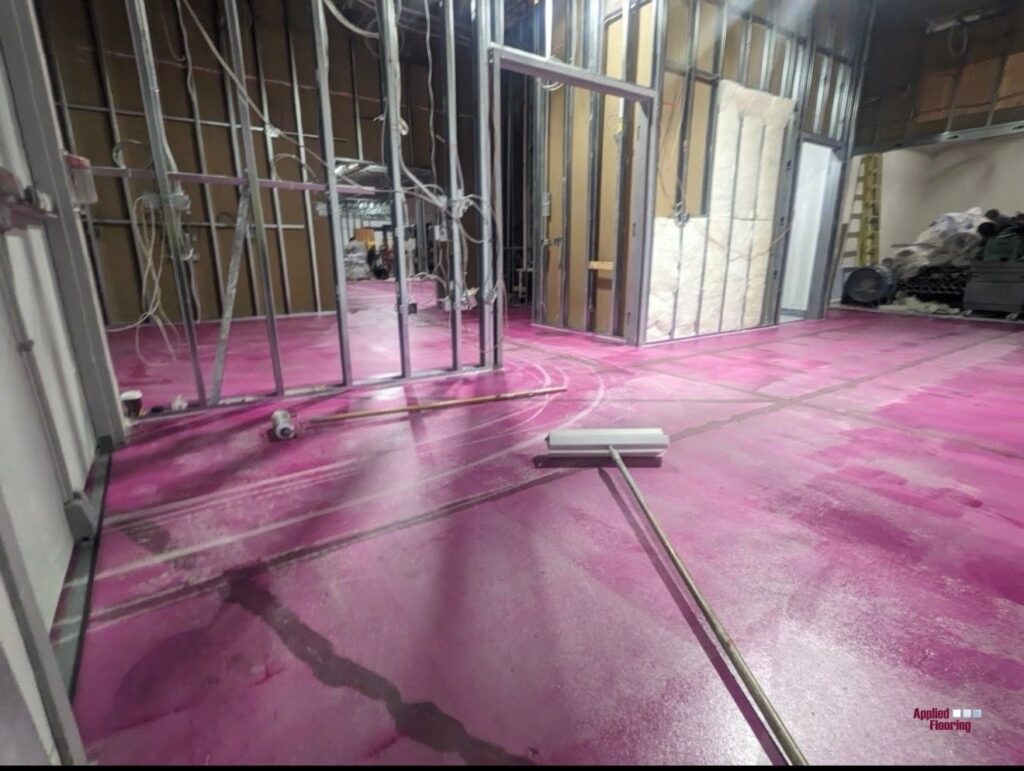
Once CSP and cleanliness are controlled, the next question becomes primer selection. This is where misunderstandings tend to cascade into systemic failure. Primers are not universal; they are engineered to solve different substrate absorption behaviors.
On non‑porous surfaces—old epoxy coatings, steel‑troweled concrete, glue residues, or well‑bonded non‑absorbent membranes—the priority is creating a tenacious bonding interface. Here, high‑performance, resin‑rich primers with broadcast options or specialized bonding agents are mandatory. Without them, the SLU is essentially sitting on a glass plate. These primers are formulated to chemically grip a slick surface while providing a tooth for the leveler to anchor into. Many manufacturers require a sand broadcast to refusal on extremely dense surfaces to achieve a reliable mechanical lock.
Highly porous substrates sit on the opposite end of the spectrum. These are slabs that absorb water quickly, often made of old, dry, or heavily profiled concrete. Pour a leveler directly over that, and the substrate will strip the mix water from the product before hydration is complete. The result is pinholing, surface weakness, and loss of compressive performance. Porous‑surface primers are specifically designed to slow absorption, equalize the slab’s suction rate, and prevent rapid water loss. Sometimes multiple primer coats are needed, especially if the surface continues to “drink” primer during the first application. The goal is uniform film formation—not simply coverage.
Standard or moderately porous concrete sits between these two extremes, and here the choice is less dramatic but still critical. The primer selected should stabilize the substrate, lock down residual micro‑dust, and ensure consistent hydration. It is often the simplest scenario, but ignoring manufacturer‑specified dilution rates or recoat windows can still introduce risk. Primers are chemistry, not paint—over‑diluting, over‑applying, or allowing the primer to dry beyond its recoat tolerance can compromise the entire assembly.
QA/QC and How to Make Your SLU Project a Success
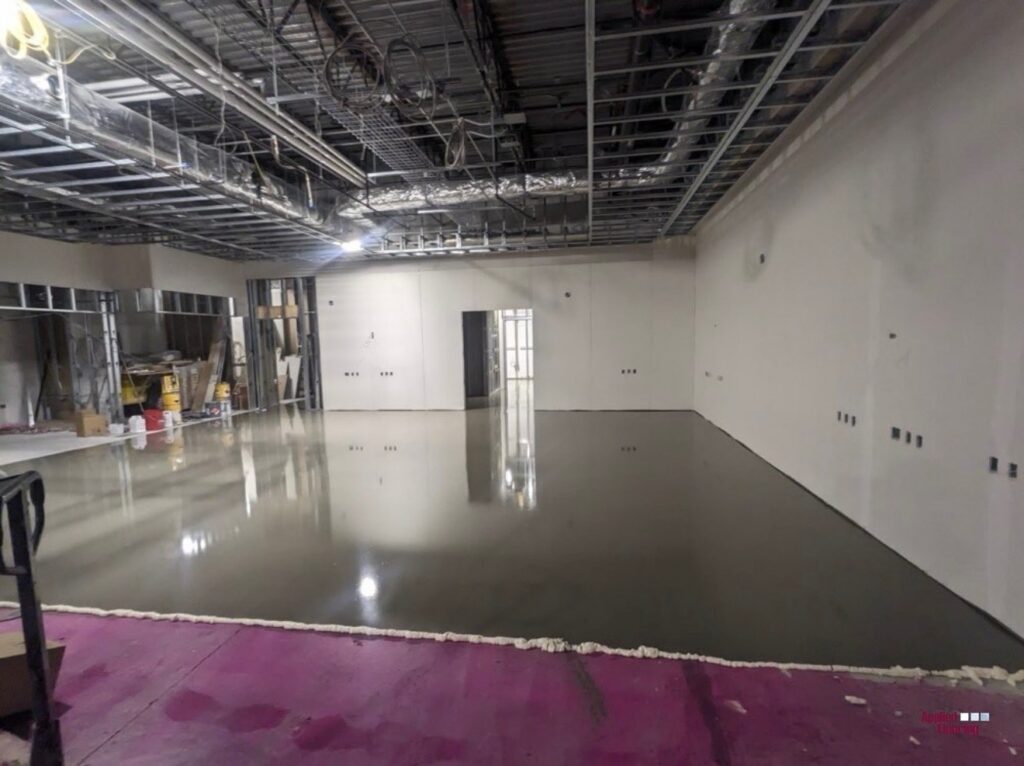
Quality control is less about inspection and more about discipline. Moisture checks, substrate tensile pull tests, CSP verification, primer film‑thickness monitoring, and environmental controls—all of these define whether the installation is predictable or problematic. The best installers follow a consistent rhythm: evaluate, profile, clean, prime, verify. They understand that cementitious levelers are engineered materials, and that each upstream decision influences hydration, flow, bond, and long‑term durability.
Failures don’t happen because SLUs are fragile products; they happen because the substrate wasn’t respected. When preparation is treated as the critical path—not the necessary inconvenience—cementitious levelers perform as intended: flat, strong, and permanent. In flooring, success isn’t determined by how well the pour looks; it’s determined by everything that occurred before the first batch was mixed.


