



As warehouses race toward automation — AMRs, ASRS, AGVs, G2P robotics — one critical infrastructure element still gets overlooked far too often: the concrete floor. Yet it’s the single physical surface every robot depends on. And when the floor underperforms, automation slows, faults out, or fails before it ever reaches peak throughput.
Common Concrete Floor Issues
Here are the most common concrete floor issues that disrupt or delay automation deployments:
1. Poor Flatness & Levelness
Modern robotics demand extremely tight tolerances. Even small deviations cause AMRs to drift, VNA trucks to fault at height, or ASRS shuttles to misalign during retrieval. Many systems require:
- Fmin 80–100 for VNA aisles
- FF/FL 45/35 for AMRs/AGVs
- TR34 DM2 / EN 15620 DM2 for ASRS systems If the slab doesn’t meet these numbers, the system compensates by slowing down, vibrating, erroring out, or stopping entirely.
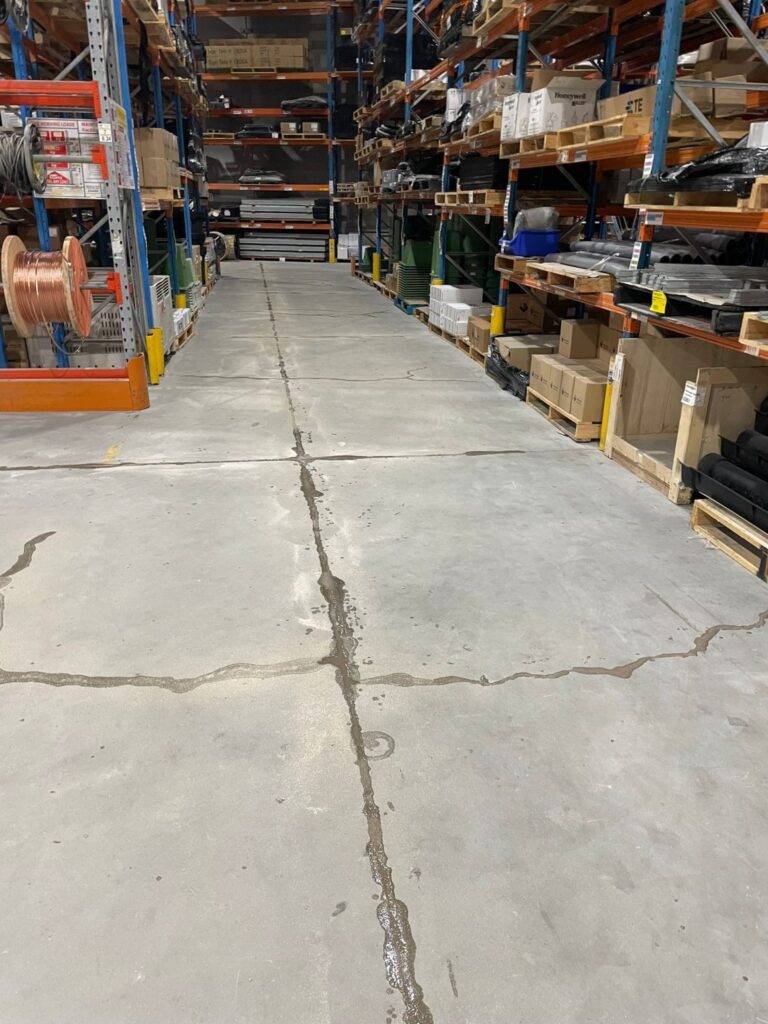
2. Joint Curling, Cracks & Edge Breakdown
Joints are the hidden disruptors of automation. Curled or damaged joints can trigger:
- Robot sensor faults
- Wheel misalignment
- Excessive vibration
- Premature mechanical wear
These issues are especially common in older or leased facilities now being retrofitted for automation.

3. Surface Defects, Dusting & Inconsistent Reflectivity
G2P systems, AMRs and AGVs rely on vision systems such as LiDAR, QR markers, reflectors, and camera-based navigation. Surface defects — dust, patchy repairs, delamination — break visual continuity and interrupt pathfinding. Surface micro-roughness, gloss, and friction must often meet specific criteria for automation performance.
4. Floors Not Designed for Modern Load Patterns
ASRS systems apply unique point loads, wheel loads, and dynamic loads, which can overstress unprepared slabs — leading to cracking, deflection, or long-term structural fatigue. Retrofitted facilities are especially vulnerable if floors were not originally designed for automation-era traffic and load profiles.
Why Early Identification Matters
Across multiple Applied’s case studies, the root cause of automation failure is often not software, calibration, or hardware — but a floor that wasn’t prepared to support the technology. Identifying disruptors early:
- Prevents commissioning delays
- Avoids costly rework after automation is installed
- Ensures robots achieve the designed pick rates and travel speeds
- Protects equipment from vibration-related wear
Prevents shutdowns caused by tolerances out of spec Proactive floor surveying enables timely corrections before automation hits the floor — avoiding the cascading costs of downtime and missed go-live dates.
The Path to Maximum Efficiency & Best ROI
1. Comprehensive Floor Survey & Testing
Specialist floor testing identifies flatness deviations, joint instability, surface inconsistencies, and load-related risks. This is the foundational step for any automation-ready floor (AMR, ASRS, G2P).
2. Targeted Remediation for Fast ROI
Applied reports operators often achieve ROI in 12–18 months by executing the right improvements early:
- Precision grinding or ultra-flat shaving to meet Fmin/Ff/FI tolerances
- Joint repair to stop curling and edge breakdown
- Surface leveling to reduce vibration in ASRS operations
- Epoxy, coatings, and safety marking for navigation clarity and durability
These enhancements dramatically reduce downtime and increase the lifespan of high-value automation systems.
3. Designing for Long-Term Performance
Taking a proactive, engineered approach to the floor ensures the automation operates at full speed and consistency — improving picking rates, reducing maintenance, and ensuring your chosen system delivers its promised ROI.


