



As more Canadian warehouses and fulfillment centres adopt Logistics 4.0 technologies — robotics, AGVs, ASRS systems, automated conveyors, and AI-driven WMS platforms — conversations naturally lean toward throughput, data integration, and system design.
But one foundational element is still too often overlooked: the concrete floor that everything runs on.
1. Understanding the Problem
When automation fails, the blame often falls on system calibration, software issues, or equipment setup. But in practice, we’ve seen time and time again that the root cause is often far simpler: the floor wasn’t prepared to support the technology.
Whether it’s an AMR drifting off path, an ASRS shuttle misaligned during retrieval, or a VNA lift truck triggering a fault at height — these performance issues frequently stem from flatness deviations, uncontrolled joint movement, or unexpected surface inconsistencies.
And for facilities retrofitting older slabs, the risks multiply. Joints curl, patches wear, and tolerances never designed for robotics are suddenly asked to meet machine-grade expectations. Automation doesn’t just need a solid floor. It needs a measured, planned, and optimized one.
2. How Flooring Fits into Logistics 4.0
The logic is simple: smart systems need predictable conditions. But logistics environments are anything but simple — with high traffic, changing layouts, and aggressive demands on surface performance.
Flatness and Levelness
Automation requires a tighter tolerance window than conventional forklift traffic ever did:
- VNA systems need Fmin 65–100 over full-aisle grinding
- AMRs and AGVs function best with FF/FL 45/35 or better
- ASRS and shuttle systems often require TR34 DM2 or EN 15620 DM2 to operate within design specs
If the slab doesn’t meet those numbers, your system compensates — usually by slowing down, stopping, or breaking down.
Joints and Cracks
These are the hidden disruptors of robotic performance. A single curled joint can trigger:
- Sensor faults
- Wheel misalignment
- Accelerated wear
- Vibration that reduces accuracy
We’ve seen this across industries, especially in facilities converting from manual to automated handling without adjusting for slab movement. In high-speed zones, jointless panel design, polyurea-filled joints, or armored edges can offer long-term performance.
Surface Quality and Visual Navigation
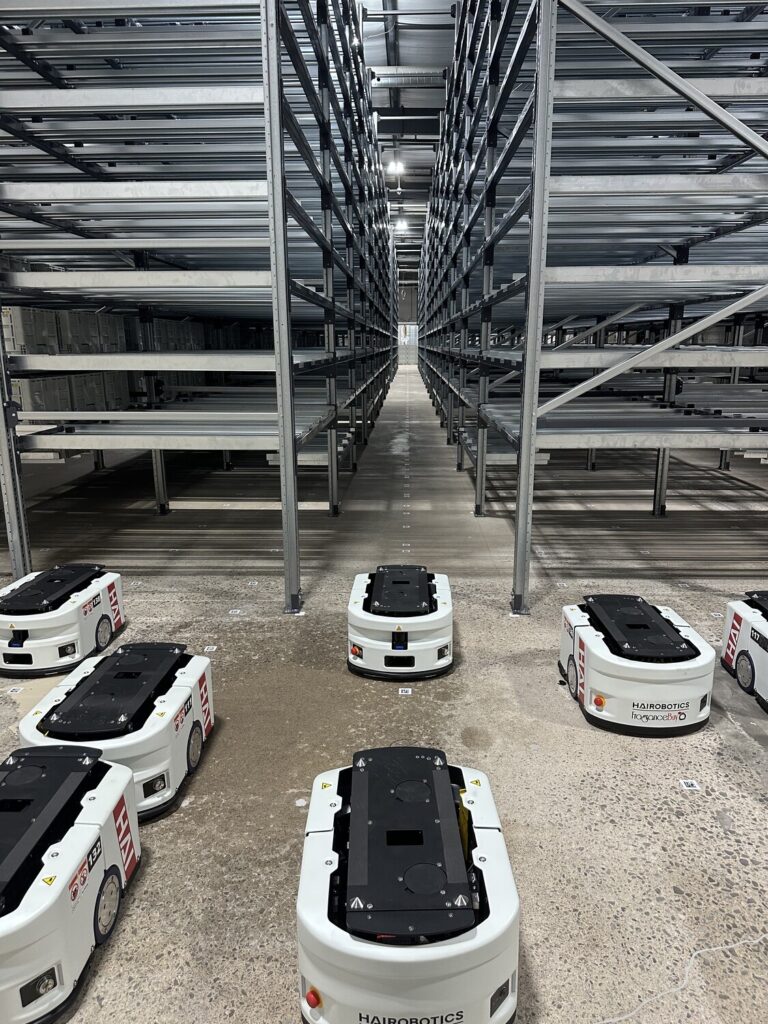
Many AGVs use reflective markers, QR codes, or LiDAR — all of which rely on a clean, uniform surface. Dust, delamination, or patchy repairs interrupt their pathfinding. At the same time, human operators need non-slip texture, visual clarity, and zone marking.
Balancing both means selecting finishes carefully — precision concrete in AGV lanes, urethane mortar in wet areas, and epoxy with high-lumen striping in shared zones.
3. What Actually Solves the Problem
From experience, the biggest gains come when the floor is treated as part of the automation system — not just a base layer. That means project teams ask better questions upfront:
- What tolerances do our lift trucks or AGVs really need?
- Are we installing wire guidance or relying on visual navigation?
- Will the slab deflect under rack loads or robotic movement?
- How will joints behave under repeated daily traffic?
The teams that ask these questions early almost always avoid the last-minute fixes — rushed grinding, overnight patching, or re-routing automation paths due to slab inconsistencies. Instead of overhauling the entire floor, sometimes the best solution is:
- Targeted grinding in AGV aisles only
- Localized overlays using Ardex or TRU PC in racking zones
- Gridning and densification to improve reflectivity and reduce dust
- Crack repair with structural resins, not just filler
- Smart striping for robot and pedestrian path separation
What matters is solving for performance — not just pouring more concrete. It’s about aligning the floor with the system specs and the long-term needs of the operation.
If you’re already commissioning automation or preparing for retrofit, a quick tolerance survey and slab condition review can prevent major issues down the line. It’s a simple check — but it can save weeks of delays.
Logistics 4.0 only works when your floor works with it. Measure first. Plan wisely. Build for the system you’re investing in — and the uptime it promises.


