



In today’s fast-paced logistics world, where automated systems like AutoStore and Exotec’s Skypod are revolutionizing efficiency, one often-overlooked factor can make or break operations: floor flatness. Poorly surveyed floors lead to robot instability, reduced throughput, and costly downtime. As a warehouse professional, we’ve seen how precise surveying—using tools like profilographs and 3D scanners—ensures compliance and boosts ROI. Let’s explore these methods, with a primary focus on their application, and extend the discussion to VNA turret trucks and AGVs.
Why Floor Surveys Matter in Automated Environments
Automated storage and retrieval systems (AS/RS) demand ultra-flat floors to prevent vibrations, misalignments, or failures. Traditional ruler checks are outdated; modern profilographs and 3D scanners provide data-driven insights. Profilographs simulate vehicle paths for dynamic testing, while 3D scanners capture comprehensive point clouds for static analysis. Both align with standards like EN 15620:2021, but choosing the right tool depends on the accuracy needs (±0.5 mm ideal) and project scale.
Surveying with Profilographs: Precision for Defined Paths
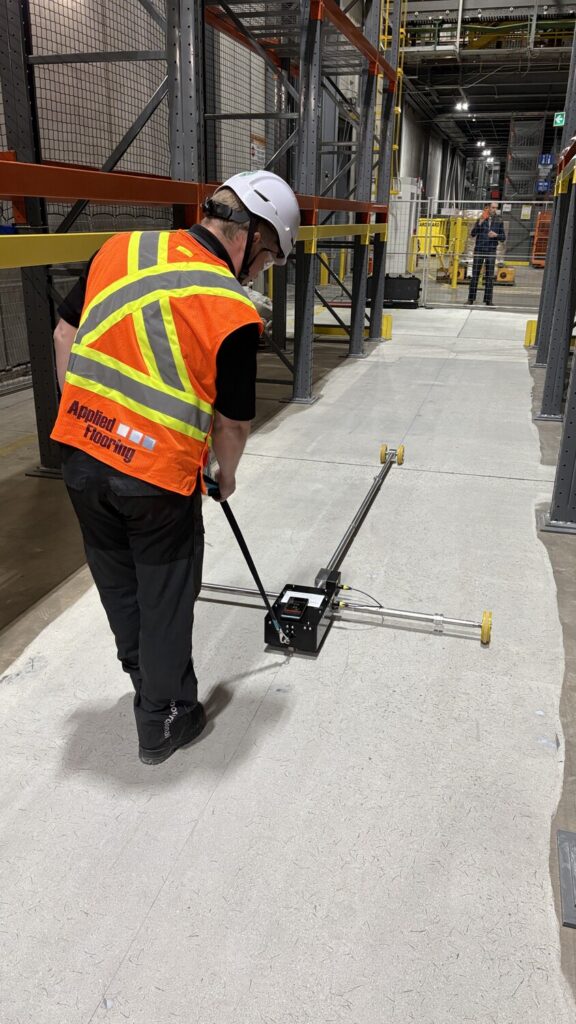
Profilographs, like the FloorProfiler, are wheeled instruments that traverse floors, measuring flatness in real-time along simulated wheel tracks. They’re ideal for warehouses with defined traffic, such as VNA aisles or robot grids, capturing transverse and longitudinal elevations simultaneously.
- How It Works: Self-propelled and configurable for 3- or 4-wheel setups, it checks properties like elevation differences over gauges (e.g., 1.2 m or 2.4 m in AutoStore). For AutoStore, survey lines are marked 1.0 x 1.0 m apart, extending beyond system boundaries, with readings every 300 mm.
- Advantages: Efficient for large areas, directly measures as the equipment “feels” the floor, and complies with EN 15620 for VNA-like ops. In Exotec setups, it complements ruler-based flatness checks (<4 mm under 1,000 mm).
- Applications: AutoStore recommends models like F Reader or Dipstick for Properties A/B (flatness/levelness), but notes profilographs can’t assess datum (Property C)—pair with optical tools for full compliance.
- Real-World Tip: On a recent project, profilographs reduced survey time by 50% compared to manual methods, allowing for the early identification of issues like joint curling.
If you’re dealing with robotic paths, this is your go-to for actionable, vehicle-specific data.
Surveying with 3D Scanners: Comprehensive Point Cloud Analysis
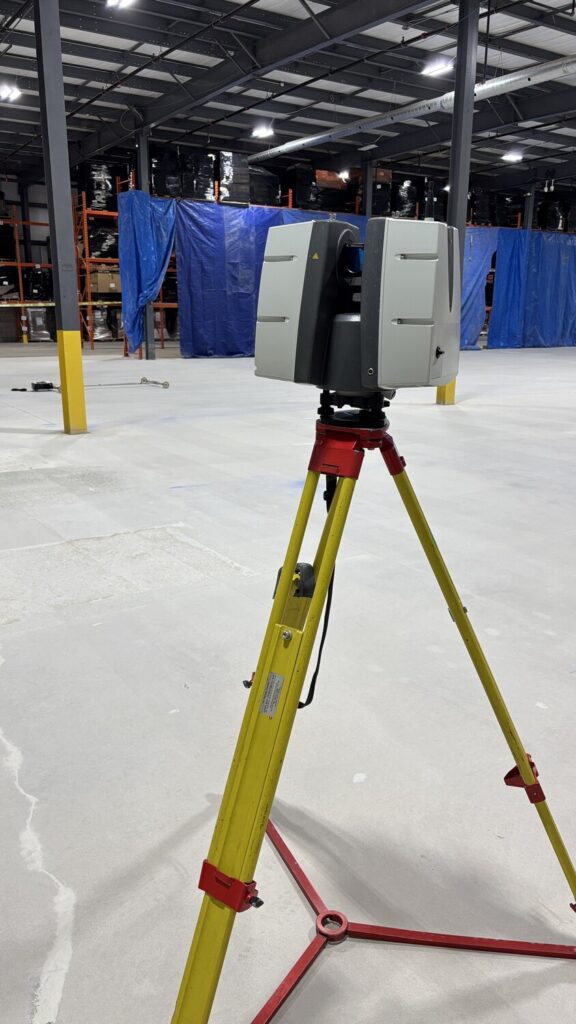
3D laser scanners, such as Leica or Topcon, generate detailed point clouds for heat maps, contours, and FF/FL (floor flatness/levelness) reports. They’re transformative for automation, capturing entire floors quickly without contact, ideal for pre- and post-pour verification.
- How It Works: Emit laser beams to plot millions of points, analyzing deviations (e.g., <±2 mm accuracy). Software integrates with Navisworks for real-time FF/FL on wet/dry concrete. For AutoStore, use on 3 x 3 m grids for Property C (with a maximum deviation of ±20 mm); Exotec benefits from geometer surveys (with a maximum deviation of ±5 mm) enhanced by scans.
- Advantages: Visual outputs (e.g., cut/fill analysis) instantly spot high/low areas, reducing rework. Faster than profilographs for broad overviews, with no need for grid marking.
- Limitations: AutoStore notes that current scanners fall short of a ±0.5 mm tolerance, with accuracy dropping over distance; supplement with profilers for precision. Not ideal for dynamic wheel-path simulation.
- Applications: In Skypod installations, scans verify rack zones (20 mm over 10 m); for AutoStore, they aid in greenfield designs by mapping irregularities, such as hollows (<30 mm acceptable if isolated).
Hybrid approaches—profilograph for paths, scanner for visuals—yield the best results, as we’ve implemented in multiple facilities. Non-compliance? Grind, screed, or replace—scans help prioritize fixes.
Extending to VNA Turret Trucks and AGVs: Tailored Floor Needs
For hybrid warehouses that blend AS/RS with traditional equipment, surveys must account for VNA turret trucks (e.g., Linde 4-wheel models) and AGVs (with 3- or 4-wheel configurations). EN 15620:2021 (incorporating VDMA) applies here, with an emphasis on profilograph surveys.
- VNA Turret Trucks: Require superflat floors (DM1-DM3 classes) to handle lifts up to 17 m. Tolerances: Tables 5/6a/6b in EN 15620 (e.g., <3 mm transverse over wheelbase). Profilographs simulate 3/4-wheel tracks; 3D scanners aid but lack a dynamic feel. Uneven floors cause lean, slowing ops—aim for F-min 100.
- AGVs (3-Wheel vs. 4-Wheel): 3-wheel AGVs adapt better to minor irregularities (similar to single-drive), with lower flatness demands but risk tipping on slopes. 4-wheel models need stricter flatness (>FF 75/FL 65) to avoid wheel hang or navigation errors. Surveys: Profilographs for paths; scanners for overall mapping. ISO 3691-4 ensures safety (PLd-rated stops). In ramps, align wheels parallel for an even load.
Integrate these with AS/RS surveys for seamless ops—profilographs excel here for vehicle-specific testing.
Special Considerations for Implementation
- Greenfield vs. Retrofits: New builds minimize curling (<10 mm after cure); scanners shine for pre-pour.
- Fire/Environmental: Exotec details shutter holes; both systems need pore-free concrete.
As automation evolves, robust surveys are non-negotiable. What challenges have you faced with floor flatness? Share your thoughts in the comments or connect for tailored advice—let’s overcome those hurdles!


