



Why Every Millimeter Matters
In high-bay warehouses with Very Narrow Aisle (VNA) trucks, the floor isn’t just concrete—it’s the backbone of your operation. Every millimeter counts. Yet many projects still rely on ACI’s Fmin specification as the benchmark for flatness. On paper, Fmin looks acceptable. In reality, it was designed for conventional forklifts, not for 14-meter-high masts moving at speed in aisles barely wider than the truck itself.
The Problem with Fmin
Fmin measures flatness over short intervals and averages deviations. A floor can pass Fmin while hiding localized bumps, dips, or waves that wreak havoc on VNA trucks. These imperfections cause:
- Mast oscillation and lateral sway
- Increased vibration and operator discomfort
- Accelerated wear on bearings and running gear
- Higher maintenance costs and forced speed reductions
The result? Lost productivity and rising operational costs.
About VDMA
VDMA was developed at the request and with the approval of VNA forklift manufacturers, flooring contractors, engineering firms, and universities, based on years of scientific research. It is the only standard worldwide that controls all undulations influencing forklift driving behavior.
What Makes VDMA Unique
- Short-wave undulations measured continuously over 50 mm, calculated statistically, expressed as Fx value. Recommended minimum Fx values: Up to 6 m lift: 300 10 m lift: 400 15 m lift: 525
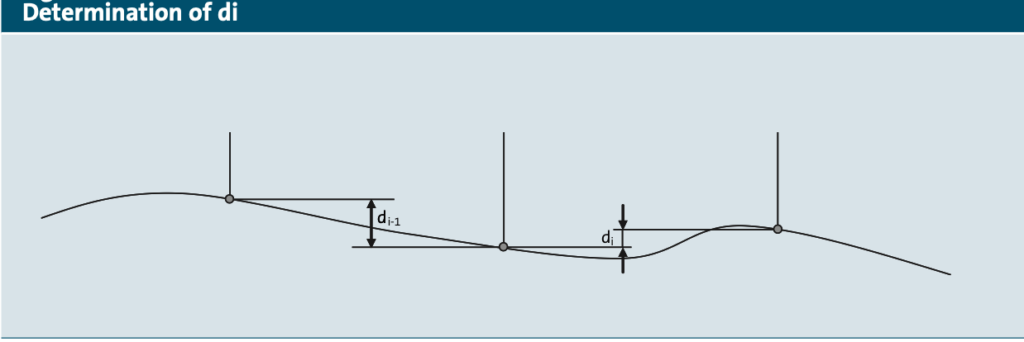
- Medium and long-wave undulations checked over 1m, 2m, 3m, and 4m distances.
- Height difference between tracks (left and right) calculated based on lift height and truck width.
- Integrated into FEM 10.2.14 / 4.103-1 and officially part of EN 15620 since September 2021.
Why It Matters
Short waves cause shocks and vibrations, leading to:
- Health issues and operator fatigue
- Reduced forklift lifespan and reliability
- Frequent stoppages and high maintenance costs
Medium/long waves cause:
- Speed reductions due to fluctuations
- Risk of rack collisions and pallet damage
VDMA addresses all these factors, guaranteeing maximum efficiency and profitability:
- Minimum number of VNA trucks and drivers
- Full-speed operation
- Maximum safety
- Minimum maintenance costs
- Maximum equipment lifespan
Key Technical Parameters from VDMA
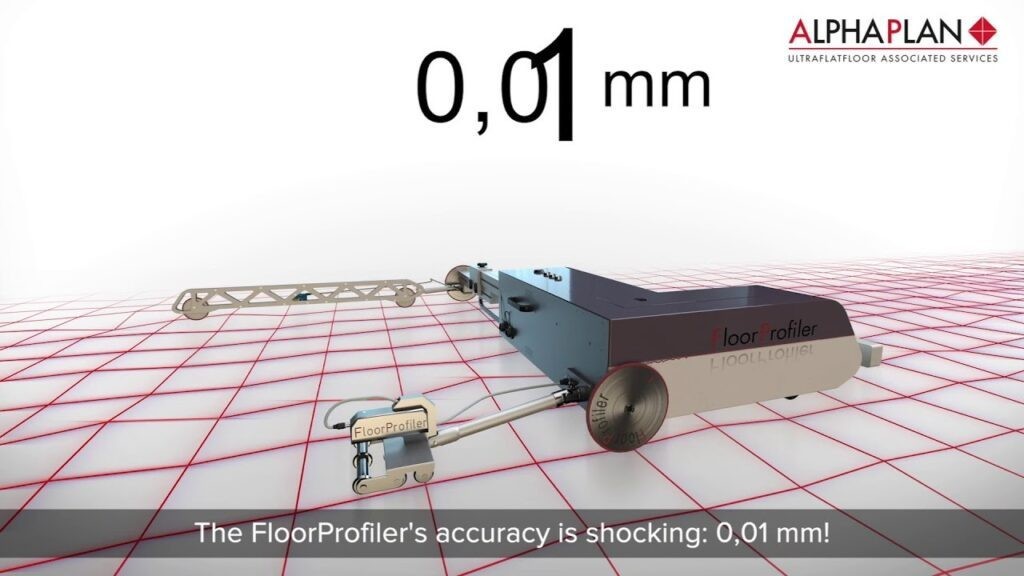
- Fx Waviness Number: Continuous measurement along wheel tracks, subdivided into 50 mm intervals.
- Flatness Tolerances: 1 m gap ≤ 2 mm, 4 m gap ≤ 5 mm
- Levelness: All points on any 3 m grid within ±15 mm of datum.
- Z Slope: Cross-aisle slope limits based on beam height (e.g., 1.0 mm/m at 15 m).
Why VDMA Is Different
VDMA evaluates the floor as a continuous path—the way a VNA truck actually experiences it. The Fx parameter isn’t just a number; it’s a stability guarantee. It accounts for dynamic behavior, ensuring trucks can travel at full speed without rocking or mast deflection. VDMA doesn’t just check compliance—it predicts performance.

Benefits for End Users
- Lower Maintenance Costs – Less stress on running gear and mast bearings
- Higher Productivity – Trucks run at full speed without vibration
- Improved Safety – Reduced mast sway minimizes rack collision risk
- Better Operator Comfort – Less fatigue, fewer mistakes
- Future-Proof for Automation – Perfect for ASRS, AutoStore™, Exotec, Geek+, and more
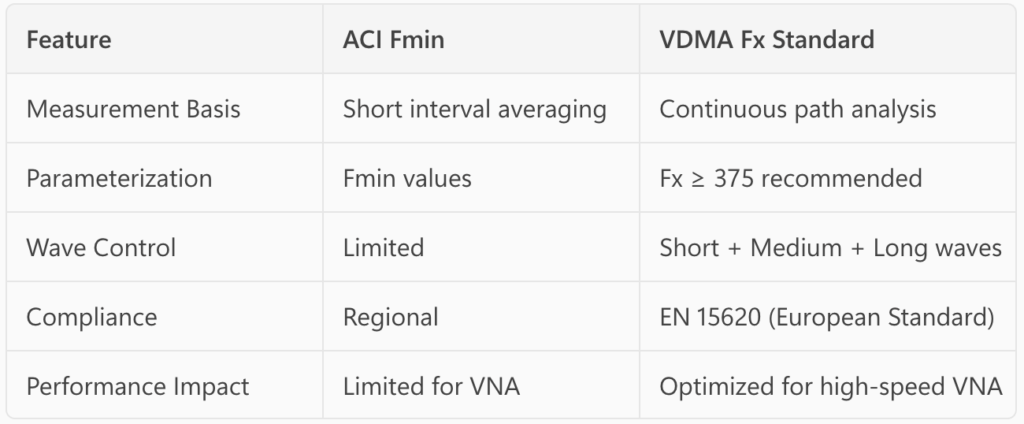
Technical Comparison: VDMA vs ACI Fmin
Checklist for Warehouse Managers
- Specify Fx values for short-wave and long-wave control
- Ensure EN 15620 compliance for defined traffic areas
- Validate correlation between Fx classification and operational speed
- Assess compatibility with AGV and ASRS systems
- Include ISO-based measurement protocols in QA process
Bottom Line
VDMA delivers superior operational stability by controlling undulation wavelengths that ACI Fmin does not address. This ensures optimized travel speeds, reduced vibration-induced wear, and full compliance with European and international standards. For warehouse operators, this means maximum throughput, minimum downtime, and the best ROI on your equipment investment. #VDMA #VNA


